Olive Oil from Sierra Nevada: When Altitude Becomes Flavour
Olive Oil from Sierra Nevada: When Altitude Becomes Flavour
When you think of olive oil in Spain, you think of Jaén. And rightly so: Jaén produces more oil than the whole of Greece. It is a sea of olive trees stretching across the plains, at 300–600 metres altitude, with long, hot summers.
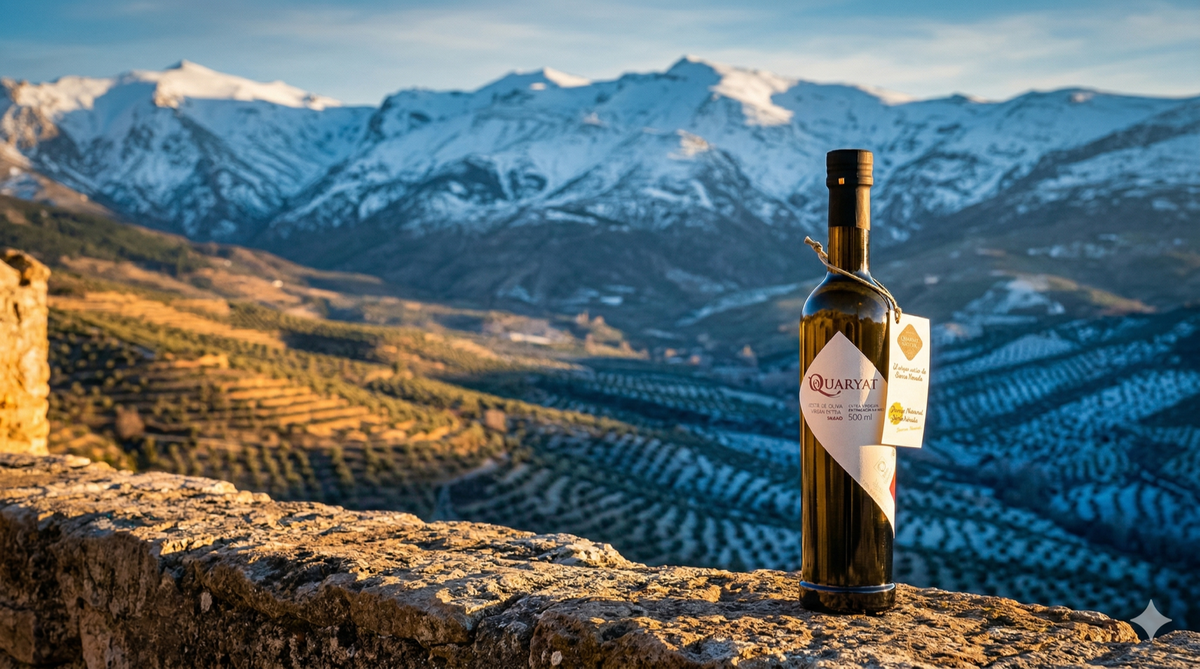
But 100 kilometres to the south, on the slopes of Sierra Nevada, there are olive groves playing by different rules. Groves at 1,000, 1,200, 1,300 metres altitude. With cold nights even in summer. With a temperature swing between day and night that fundamentally changes the character of the olive.
And from there come oils that are starting to turn heads at international competitions.
The biology of altitude
The olive tree is a plant that responds to stress. When conditions are comfortable — stable temperature, enough water, fertile soil — the olive grows well, fattens quickly and yields plenty of oil. But an oil without great complexity.
When conditions are demanding — cold nights, poor soil, controlled drought — the olive produces more defence compounds. More polyphenols, more antioxidants, more aromas. It is the same mechanism as in wine: vines that struggle produce more concentrated grapes.
Above 1,000 metres, several things happen:
- Extreme temperature swing — The difference between the daytime high and the night-time low can exceed 20 °C. This slows ripening and concentrates aromas.
- More UV radiation — The olive tree generates more polyphenols to protect itself from the sun.
- Slower cycle — The olive takes longer to ripen, allowing more time to accumulate compounds.
- Controlled stress — The demanding mountain conditions — poor soil, drought, cold — force the olive tree to generate more defence compounds.
Dílar: the almazara at the foot of the mountain
In Dílar, 15 kilometres from the city of Granada, the Velasco family founded Quaryat Dillar in 2009. Their estate, Las Ánimas, spans 130 hectares of olive groves between 1,000 and 1,300 metres. They cultivate Picual, Arbequina, Hojiblanca and Picudo.
The name "Quaryat" comes from the ancient Arabic word for "village" — the original place name for Dílar. It is a nod to the centuries of agriculture the area has seen.
The almazara (olive oil mill) holds Integrated Production certification and carries the Sierra Nevada Natural Park Product seal. The harvest is done early, while the olives are still green, and milled the same day.
In 2024, their Picual received the second Mario Solinas Prize from the International Olive Council, in the medium green fruity category. It was the only oil from the province of Granada among the winners. In 2021, it was named Best Oil in Spain at the EVO IOOC in Italy.
These are not chance results. They are the consequence of farming where most would not dare.
Granada: the underestimated province
Granada is the fourth-largest olive-oil-producing province in Andalucía, behind Jaén, Córdoba and Sevilla. Historically it has been in the background. But that is changing.
Besides Quaryat, Granada is home to O-MED in Ácula (three-time best oil in Spain), the oils of the Valle de Lecrín, and a generation of small almazaras that are betting on quality over volume. Even outside the province, projects like Pago de Peñarrubia in Albacete show that the mountain-quality model is spreading.
What unites them all is geography: altitude, microclimates, and varieties that express themselves differently from how they do on the plains. The same Picual planted in Martos (Jaén, 700 m) and in Dílar (1,200 m) produces recognisably different oils.
What altitude cannot replace
Altitude without process is worthless. A mountain olive harvested late and milled three days later loses everything the altitude gave it. The complete equation is: exceptional raw material + impeccable process.
The Sierra Nevada almazaras that are making a name for themselves understand this: early harvest, immediate milling, cold extraction, storage in stainless steel under controlled atmosphere. The mountain provides the raw material. The rest comes from the master miller.
So take note: next time you see "Sierra Nevada olive oil" or "Granada olive oil", do not dismiss it for not being from Jaén. You may be looking at something the plains, for all their volume, simply cannot replicate.