Cooking with Extra Virgin Olive Oil: A Myth-Free Guide
Cooking with Extra Virgin Olive Oil: A Myth-Free Guide
There is a widespread belief that extra virgin olive oil is only for salads. That you need a different oil for frying. That it burns, loses its properties, that it is a waste. Let us set the record straight.
Can You Fry with Extra Virgin?
Yes. Full stop.
Extra virgin olive oil has a smoke point between 190 °C and 215 °C, depending on the variety and quality. A standard home frying is done between 160 °C and 180 °C. There is plenty of margin.
Moreover, extra virgin is the most stable fat for cooking. Several studies — including one from the University of Barcelona published in Food Chemistry — have shown that extra virgin olive oil resists thermal degradation better than sunflower, rapeseed, and coconut oil.
Why? For two reasons:
- High oleic acid content — a monounsaturated fat that withstands heat well
- Polyphenols — they act as antioxidants and protect the oil during cooking
The data confirms it: in various repeated frying tests with potatoes, extra virgin olive oil degrades significantly less than refined or seed oils. Food palatability is also superior with extra virgin in successive fryings, and after multiple frying cycles the alteration of fats is notably lower. Professor Gregorio Varela Mosquera, president of the Fundación Española de Nutrición, extensively documented this behaviour: he discovered how olive oil acts on carbohydrates on the food surface during frying differently from other oils, which explains why Spanish churro makers have always preferred olive oil.
So no, it does not burn. No, it is not dangerous. And no, it does not lose all its properties.
But... Is It Worth It?
That is the real question. Yes, you can. But think about what happens when you fry: you subject the oil to high temperatures for minutes. Some of the volatile aromas evaporate. Some of the polyphenols degrade. What remains is still better than any refined oil, but it is no longer the same as what you had in the bottle.
The practical rule:
- Raw — use your best oil. This is where you notice everything: aromas, flavour, texture. A good Picual on toast, an early-harvest EVOO over a carpaccio.
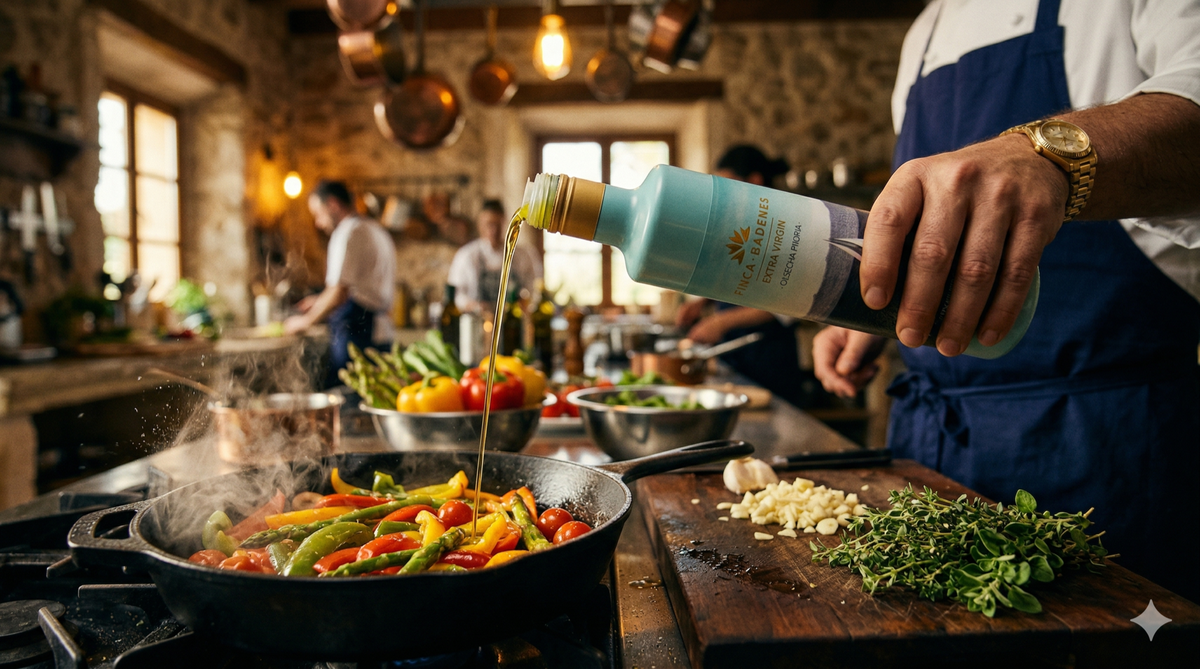
- Gentle cooking (sautéing, oven-roasted vegetables, stir-frying) — a medium-high quality EVOO works perfectly. The aromas integrate into the dish and add complexity.
- Frying — a decent EVOO or a virgin olive oil (without the "extra") are sensible options. Do not use your 20-euro bottle to fry croquettes.
Reference Temperatures
| Technique | Temperature | Recommended Oil |
|---|---|---|
| Raw | Room temperature | Your best EVOO |
| Gentle sauté | 80-120 °C | EVOO |
| Stir-fry | 140-160 °C | EVOO |
| Oven | 160-200 °C | EVOO (careful above 200 °C) |
| Frying | 160-180 °C | EVOO or virgin |
| Intense frying | 180-200 °C | Virgin or olive oil (commercial category: blend of refined and virgin — not to be confused with EVOO) |
EVOO in Baking
This may sound odd if you have not tried it, but extra virgin olive oil works extraordinarily well in baking. A quality Arbequina, with its sweet, fruity profile, replaces butter with advantage:
- Cakes — fluffier and more aromatic. Replace 100 g of butter with 80 ml of oil
- Biscuits — crispier texture, cleaner flavour
- Muffins — the fruit and herb aroma is subtle but present
- Tart doughs — lighter and more digestible
The key is to use an Arbequina or a mild Hojiblanca, not an intense Picual (unless you want a chocolate cake with bitterness — which also works, but that is already chef-level cooking).
Which Oil for Which Dish
A quick guide based on intensity:
Intense oil (Picual, Cornicabra, Coratina):
- Red meats, game
- Pulses (lentils, chickpeas, beans)
- Aged cheeses
- Grilled vegetables
- Pan con tomate
- Dark chocolate
Medium oil (Coupage, Hojiblanca):
- Pasta
- Rice dishes
- Oven-roasted vegetables
- Sautés
- Versatile daily use
Mild oil (Arbequina, Picudo):
- White fish, seafood
- Fruit salads
- Steamed vegetables
- Baking
- Creams and purées
- Ice cream (yes, a drizzle of Arbequina over vanilla)
The Final Rule
If you are only going to remember one thing: do not be afraid of heat, but save the best for raw. That is where your oil expresses everything it has.
And if someone tells you that EVOO is not for cooking, ask them what people in the Mediterranean have been cooking with for the last 4,000 years.