Arbequina Olive Oil: Everything You Think You Know Is Probably Wrong
Arbequina Olive Oil: Everything You Think You Know Is Probably Wrong
If you ask someone who knows a bit about olive oil, they will tell you that Arbequina is the mild variety, the beginner oil, the one that is neither bitter nor peppery. And that is true... halfway.
An industrial Arbequina, harvested in December, processed in a massive almazara (olive oil mill) and bottled months later, is indeed mild. So mild it hardly tastes of anything. But an early-harvest Arbequina, milled within hours and cold-extracted, is a complex, aromatic oil with far more personality than it gets credit for.
The variety is the same. What changes is everything else.
Where Arbequina Comes From
Arbequina takes its name from Arbeca, a village in Lleida. It is a Catalan variety that for centuries was confined to northeastern Spain. From the 1990s, its cultivation expanded across the entire peninsula and halfway around the world — Argentina, Chile, Australia, California — because it has two very attractive advantages for intensive farming: it enters production quickly and adapts to hedgerow (super-intensive) plantations.
That explains why there is so much mediocre Arbequina on the market: it is cultivated in large quantities, fast, and with volume in mind.
But when a serious producer works Arbequina with the same care as an artisan Picual or Hojiblanca, the result is an oil that has nothing to do with the supermarket generic.
What to Expect from a Good Arbequina
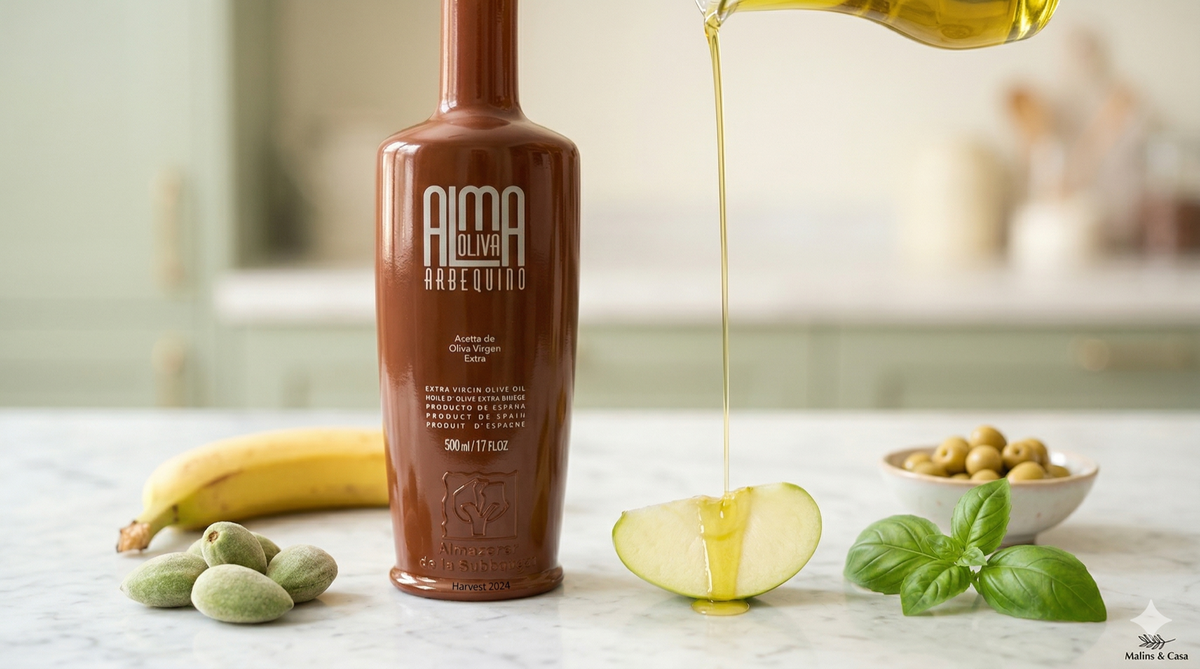
On the nose: freshly cut grass, green apple, almond, banana, sometimes hints of cinnamon or tropical fruits. The aroma is rounder and more fruity than Picual.
On the palate: a sweet entry, medium body, with a subtle peppery kick at the end that gives it life. It is not bitter (or barely so). The aftertaste can recall ripe tomato, banana, or compote.
The key: it is subtle but not empty. If your Arbequina tells you nothing on the nose or the palate, it is not that the variety is like that. It is that particular oil that is dead.
Arbequina vs Picual: Neither Better Nor Worse
It is the most frequent question and it has a simple answer: they are different oils for different moments.
| Arbequina | Picual | |
|---|---|---|
| Bitterness | Low | Medium-high |
| Pungency | Subtle | Pronounced |
| Stability | Medium | Very high |
| Polyphenols | Medium | High |
| Ideal for | Fish, seafood, baking, finishing | Meats, pulses, vegetables, bread |
You do not compete. You complement. Having an Arbequina and a Picual at home is like having fine salt and coarse salt: each has its moment.
Arbequina in Baking
This is where Arbequina shines like no other variety. Its sweet, fruity profile makes it perfect for replacing butter in cakes, biscuits, muffins, and doughs:
- Use the same amount of oil as butter (by weight)
- Reduce the sugar by 10-15%: the fruitiness of the oil compensates
- The result is lighter, more aromatic, and easier to digest
A cake made with good Arbequina has an aroma you cannot achieve with butter. It sounds strange until you try it.
And there is another use where Arbequina shines particularly: mayonnaise. Its mild, fruity profile, without dominant bitterness, makes it the ideal oil for emulsifying a homemade mayonnaise with personality — without the oil overpowering.
How to Choose a Good Arbequina
- Check the harvest date — October or early November
- Look for a specific origin — estate, almazara, village. If it does not say, it is probably an industrial blend
- Taste it — it should smell of something (grass, fruit, almond). If it has no smell, move on
- Note the packaging — dark bottle or tin. An Arbequina in a clear bottle has been losing aromas for weeks
In Granada, O-MED has spent two decades making an early-harvest Arbequina that Der Feinschmecker has ranked among the top 2 in the world. It is not the Arbequina you expect. It is the one you should expect.