Olive Oil Polyphenols: What They Are, Why They Matter and Where to Find Them
Olive Oil Polyphenols: What They Are, Why They Matter and Where to Find Them
When an extra virgin olive oil tastes bitter or peppery, some consumers assume something is wrong. It is the natural reaction of anyone accustomed to neutral oils. But that bitterness and pungency have a technical name: polyphenols. And they are precisely the reason why extra virgin olive oil is a different food from other fats.
What are polyphenols
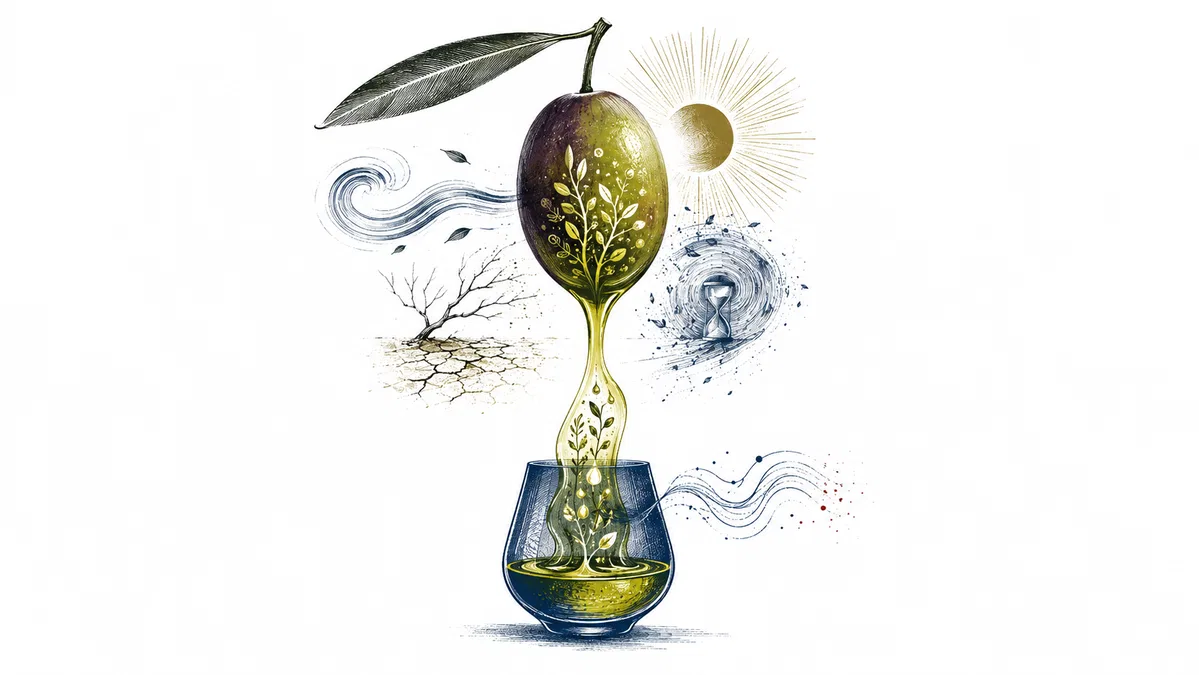
Polyphenols are bioactive compounds that the olive produces to protect itself from sunlight, pests and environmental stress. They are its natural defence system. When we extract the oil from the olive, these compounds pass into the oil.
The main polyphenols in olive oil are:
- Oleocanthal — responsible for the peppery sting in the throat. It has anti-inflammatory properties similar to ibuprofen, as demonstrated by Gary K. Beauchamp et al. in a study published in Nature (437, 45–46, 2005): it inhibits the same cyclooxygenase enzymes (COX-1 and COX-2) as ibuprofen
- Oleuropein — responsible for bitterness. A powerful antioxidant.
- Hydroxytyrosol — one of the most potent antioxidants known in nature
- Tyrosol — an antioxidant with cardioprotective effects
In total, a good EVOO can contain more than 30 different polyphenols.
Why they matter
In 2012, the EFSA (European Food Safety Authority) approved a specific health claim for olive oil, set out in Regulation (EU) 432/2012: “Olive oil polyphenols contribute to the protection of blood lipids from oxidative stress.”
It is the only fat in the world with an EU-approved health claim. But there are conditions: the oil must provide at least 5 mg of hydroxytyrosol and its derivatives (oleuropein and tyrosol complex) per 20 g of oil (about two tablespoons). That is equivalent to an oil with around 250 mg/kg of total polyphenols.
In other words: not just any olive oil qualifies. A refined oil has 0 polyphenols. A late-harvest virgin may have 80–100 mg/kg. Only a well-made extra virgin olive oil comfortably exceeds these levels.
What affects polyphenol content
1. The variety. Picual is one of the varieties with the highest polyphenol content: it can exceed 500 mg/kg in early harvest. Other high-polyphenol varieties include Cornicabra, Coratina (Italian) and Koroneiki (Greek), all capable of reaching exceptional levels. Hojiblanca ranges between 200 and 400 mg/kg. Arbequina typically stays between 100 and 300 mg/kg — which does not make it a lesser oil, just a different one.
2. Harvest timing. Green olives have the highest polyphenol content. As the olive ripens, polyphenols degrade. An early-harvest oil (October) can have double or triple the polyphenols of a late-harvest one (December–January).
3. Altitude and temperature swing. Olive trees that endure stress — altitude, drought, poor soil — generate more polyphenols as a defence mechanism. But the key factor is the temperature swing: the difference between the daily maximum and minimum temperature. The greater the swing, the more controlled stress, the more polyphenols. A mountain Picual at 1,200 metres, with 15–20 °C swings between day and night, typically has significantly more polyphenols than one from the plains at 400 metres with more stable temperatures.
4. Processing. Cold extraction (below 27 °C) preserves polyphenols. Heat destroys them. Storage in stainless steel under nitrogen atmosphere protects them. Exposure to light and oxygen degrades them.
5. Freshness. Polyphenols degrade over time. An oil from the current harvest always has more than one from the previous year.
How many polyphenols does my oil have
Most quality producers analyse their oils and can provide the data. If it does not appear on the label, ask. If they cannot tell you, it is probably not their priority.
Indicative ranges:
| Level | mg/kg | What it means |
|---|---|---|
| Low | < 150 | Late harvest or prolonged storage |
| Medium | 150–300 | Good EVOO, meets EFSA threshold |
| High | 300–500 | Early harvest, polyphenol-rich variety |
| Very high | > 500 | Picual/Coratina from early harvest, altitude |
To give you an idea: an early-harvest Picual like those produced in Sierra Nevada, where the thermal stress of altitude combines with the variety and green harvest, can comfortably exceed 400–500 mg/kg. That is three times the threshold the EFSA considers health-relevant.
How to preserve polyphenols
You already have them in the bottle. Now do not lose them:
- Darkness — light destroys polyphenols. Dark bottle or tin, always in a closed cupboard
- Stable temperature — between 15 and 20 °C. Away from the hob
- Sealed — oxygen oxidises polyphenols. Close the bottle well after each use
- Use it quickly — do not save it for special occasions. Use it daily and buy it fresh
The flavour paradox
Polyphenols are what make the oil taste bitter and peppery. And they are precisely what make it a functional food.
So next time you taste an EVOO and notice that bitterness on your tongue and that peppery sting in your throat, do not reject it. It is your body detecting the compounds that benefit it most.
That is something the label on a supermarket oil will never tell you.