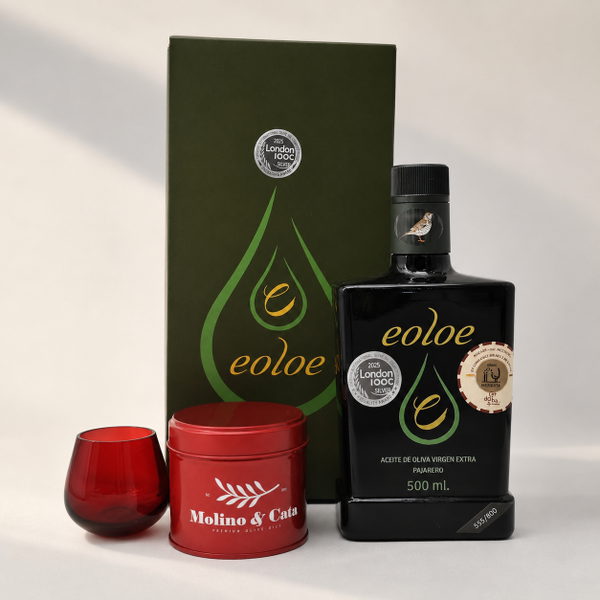
Type · Monovarietal
Pajarera
Tasting sheet
| Type | Monovarietal |
|---|---|
| Price range | 21,00 – 21,00 € |
Pajarera (also known as Pajarero) is a rare, indigenous Andalusian olive variety that produces an oil with a chilli-like pungency entirely different from Picual's. Cultivated by a handful of families in the Priego de Córdoba area, it is one of the hardest-to-find varieties in the Spanish olive oil landscape.
What is the sensory profile of Pajarera olive oil?
Intense green fruity with a distinctive, unmistakable personality. On the nose, notes of freshly cut grass, green tomato, almond, and a peculiar nuance reminiscent of fresh pepper and green chilli appear. It is an aroma unlike any other standard variety — the first time you smell it, you know you are dealing with something different.
On the palate, what surprises first is the pungency: it is not the throat pungency of Picual, but a lateral, chilli-like pungency felt on the sides of the tongue and lips. It is completely different and genuinely surprising the first time you try it. Bitterness is medium, well integrated, and the entry has a herbal sweetness that balances the whole.
When we first tasted Pajarera at the oleoteca, that pungency left us all speechless for a moment. Mercedes, myself, and the supplier who brought it — all staring into space trying to decipher what was happening in the mouth. It is the kind of oil that makes you stop and pay attention.
Origin and history
Pajarera is cultivated on family estates in the hills of Priego de Córdoba, one of the most traditional olive-growing areas in Spain. The PDO Priego de Córdoba — the oldest in Andalusia — covers this variety alongside Hojiblanca and Picudo.
The name "Pajarera" or "Pajarero" has an uncertain origin — some attribute it to birds preferring these olives, others to the shape of the fruit. What is clear is that it is a minority variety that 99% of consumers have never tasted and that survives thanks to artisan producers who believe in it.
What are the technical specifications of Pajarera olive oil?
| Parameter | Typical range | Context |
|---|---|---|
| Oleic acid | 68–76% | Good level for a minority variety |
| Polyphenols | 300–550 mg/kg | High; explains the intense pungency |
| Oxidative stability | Good | Above average thanks to its polyphenols |
| Oil yield | 15–19% | Medium-low |
| Growing area | Priego de Córdoba | PDO Priego de Córdoba |
The high polyphenols — between 300 and 550 mg/kg — explain both the intense pungency and the good stability. It is a variety that, despite its rarity, keeps well in storage. It is not a fragile oil: it is an oil with character that also stores well.
The medium-low yield contributes to its scarcity. Combined with the fact that only a handful of families cultivate it, total Pajarera production is minimal. Each season there are few bottles, and when they run out, you have to wait for the next harvest.
How to use Pajarera olive oil in the kitchen?
Pajarera is an experiential oil. It is not for everyday use — it is for moments when you want the oil to be the absolute star of the dish:
- Gazpacho and salmorejo: a final drizzle that transforms the dish with that unique chilli-like pungency
- Pulses: especially chickpeas and white beans, where the pungency adds an unexpected point of interest
- Grilled meats: lamb, ribs, offal — the pungency complements the fat and smokiness
- Toast with jamón: the contrast between the fat of the ham and the lateral pungency of the oil is extraordinary
- Blue cheeses: Roquefort, Cabrales — the chilli-like pungency against the intensity of the cheese
- Hummus and pulse dips: as a finishing touch, it adds a dimension nobody expects
Do not use it for frying or cooking — you would lose exactly what makes it unique. Pajarera is for enjoying raw, at room temperature, with attention.
Why is Pajarera special?
Pajarera is proof that Spain has an enormous and largely unknown varietal heritage. Beyond Picual, Arbequina, and Hojiblanca, there are dozens of indigenous varieties waiting to be discovered. Pajarera is one of the most expressive and surprising of them all.
We stock it at Molino y Cata for the explorers. For those who have already tried everything and are looking for their next discovery. It is the oil we bring out when a customer says "I want something I have never tried before." And so far, it has never failed: the look of surprise at the first sip is always the same.
If you enjoy discovering rare varieties, also look at Lecciana and Royal de Cazorla. Three unique experiences you will not find in your supermarket.
Further reading
Updated April 2026
Frequently asked questions
- ¿Qué tiene de diferente el picante del aceite Pajarera?
- El picante de la Pajarera no es el picante de garganta del Picual. Es un picante lateral, tipo guindilla, que se nota en los laterales de la lengua y los labios. Es una sensación completamente distinta que sorprende la primera vez y que se convierte en adictiva después.
- ¿Dónde se cultiva la variedad Pajarera?
- La Pajarera se cultiva principalmente en fincas familiares de la sierra de Priego de Córdoba, dentro de la DOP Priego de Córdoba (la más antigua de Andalucía). Es una variedad rara y autóctona que el 99 % de los consumidores no conoce. Su producción es muy limitada.
- ¿Para qué platos es mejor el aceite Pajarera?
- La Pajarera brilla sobre gazpacho, salmorejo, legumbres, carnes a la brasa, tostadas con jamón y quesos azules. Es un aceite para disfrutar en crudo como protagonista, no para cocinar a diario. Su picante tipo guindilla transforma cualquier plato donde se use como acabado.