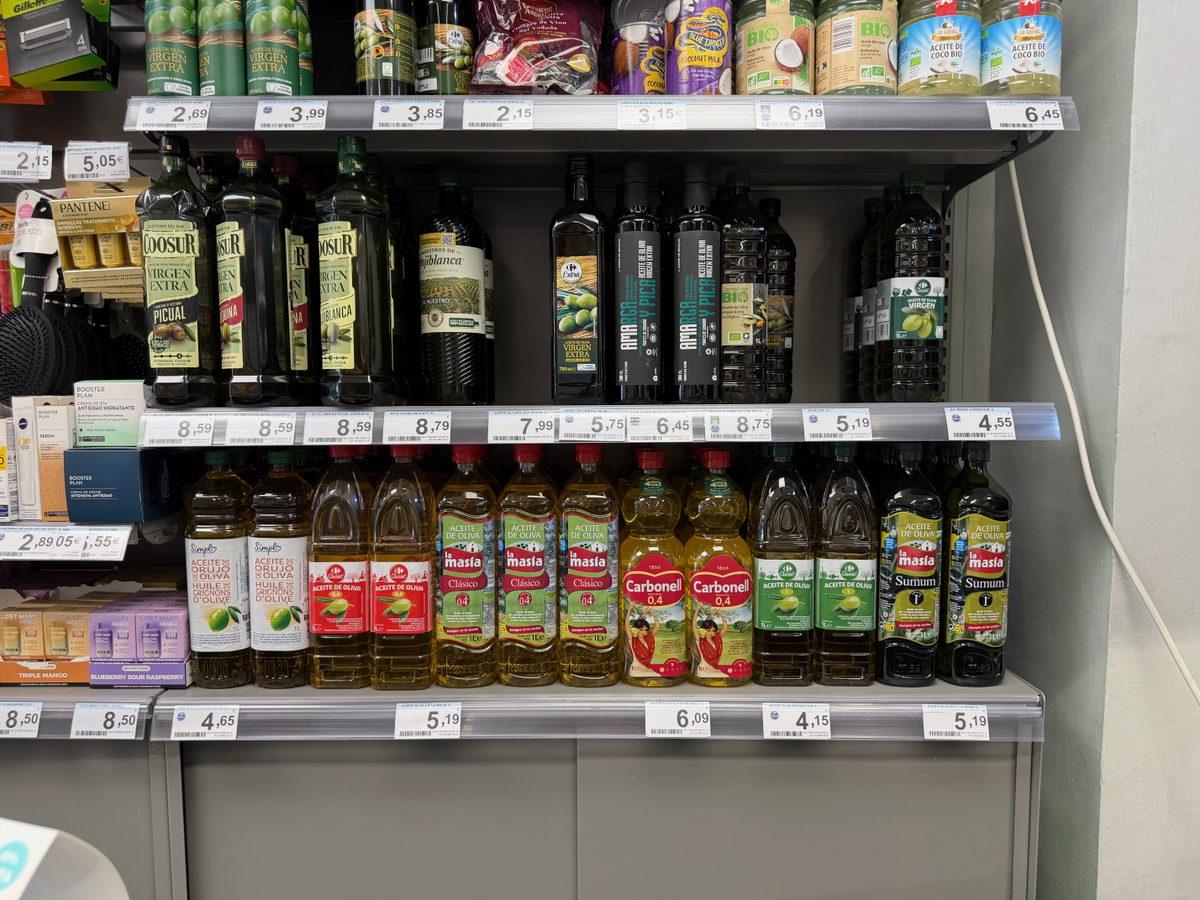
The downward pressure on olive oil prices at origin
And the inflationary pressure of brown eggs

The price of olive oil at origin is falling, yes — but far less than you're told. All through June we read the same headlines: the market is collapsing, sales aren't what was expected, consumers aren't buying.
The same old broken record.
And meanwhile, what is olive oil actually worth at origin today? Extra virgin is hovering around €3.8–3.9/kg. To give you an idea: at the end of 2024 it nearly touched double that. It has come down, but for months it has been moving between €3.5 and €4 without really collapsing.
So how is it that, in a worse-than-expected season, with the consumption we have, prices don't hold? Because neither was the production season as good as they said, nor is the selling season as bad as they paint it.
If you look back through the archives, these are the most recycled headlines of every season since the Creator threw down his trowel and said: "olive trees from here on."
When I have doubts, I ask Marino Uceda — principal researcher at IFAPA (the Andalusian Institute for Agricultural and Fisheries Research and Training), an FAO consultant on oil quality, and panel chair at the International Olive Council. He has been researching olive oil since 1975, with more than 110 publications to his name. Few people in this country have read more season headlines than he has.
"I've been reading the same news my whole professional life," he tells me. And the question asks itself: if every year the season is going to be incredible, there's going to be a surplus, consumers aren't consuming and prices are going to collapse… why has it never actually happened?
It's another case of the emperor's new clothes.
Why price doesn't always come from reality: brown eggs
Price doesn't always come from reality, but from the story you're told about it. To see it, step away from olive oil for a moment and go to the supermarket.
Pick up a white egg and a brown egg. Inside they're identical: same nutritional value, same egg. And yet many people pay more for the brown one, convinced it's "more natural" or "healthier." It isn't. They're paying for an idea that's been planted in their heads.
With olive oil the same thing happens, but in reverse. Here the story doesn't raise the price: it pushes it down.
What's behind the collapse narrative
Behind these messages there are three specific interests:
First. A well-oiled media campaign to force cooperatives and mills to release their stock at the lowest possible price. Crying wolf.
Second. A fear that — as has been happening over the last ten years — more farmers and small mills launch their own brands and sell directly to consumers, bypassing the usual marketing channels.
Third. A warning shot to those same cooperatives and mills: if they can build their own channels, their dependence on third parties to place their production — and to set their price — drops dramatically.
Who benefits from a concentrated olive oil market
An almost oligopolistic, concentrated market benefits whoever buys cheap, not the small farmer. On paper, having few players is more convenient. In practice, that only suits whoever needs to buy on the cheap.
They'll tell you concentration is necessary. And there's some truth to it: with a highly fragmented market it's hard to have valid counterparts, which is why the authorities push for consolidation into players they can talk to. The catch is that those players don't have to be neutral. They can pursue their own interests. And their interests, very often, are not yours.
Now think like a buyer
It's late June. There are about five months left before the new season's oils enter the circuit, around November or December.
There's a rule in economics: the big profit on a deal is made on the purchase, not the sale. Everything that can be pushed down now is margin for whoever buys later.
And pay attention to this: large intermediaries buying cheaper at origin doesn't mean the supermarket price will drop. The cheap part stays along the way, not in your cart.
So the next time you read that "olive oil is collapsing," ask yourself who wins if you believe it. It's not the farmer who has worked all year. It's not you.
And meanwhile, the figure that doesn't fit the narrative: global consumption of Extra Virgin Olive Oil keeps rising year after year — in 2025, EVOO shipments grew by more than 35% — while consumption of refined, mild and intense oils falls. Consumers, little by little, are learning to choose.
Try it, compare, and pay what it's worth to those who do it well. We have a lot of future ahead of us. And this is not something a label will tell you.
Frequently asked questions
Why is the price of olive oil at origin falling in 2026?
Extra virgin at origin is around €3.8–3.9/kg in June 2026, below the late-2024 highs, due to higher production and more stock. But much of the "collapse" you read is market narrative to force cheap sales at origin, not a reflection of real consumption.
If oil falls at origin, will it fall in the supermarket?
Not necessarily. Large intermediaries buying cheaper at origin doesn't mean the final price drops: the margin usually stays along the way, not in your cart.
When do the new season's oils arrive?
The new oils enter the circuit around November or December, about five months after summer. Until then, what's moving is the pressure on the previous season's stock.
Is olive oil consumption falling?
Not extra virgin: globally it keeps growing, up more than 35% in EVOO shipments in 2025. What's falling is consumption of refined, mild and intense oils.
Who benefits from a concentrated olive oil market?
Large buyers and intermediaries, who negotiate better purchase prices. The small farmer benefits from the opposite: their own channels and direct sales that reduce their dependence on third parties.