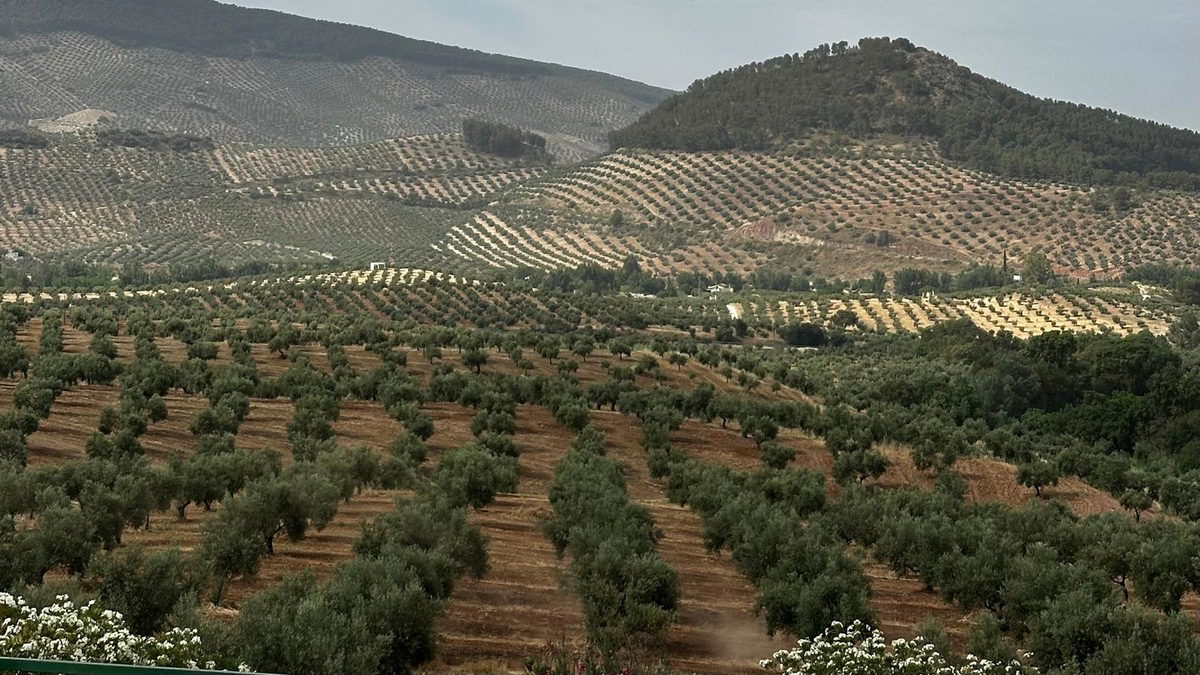
No, 75% of Spain's olive groves are not running at a loss
AEMO has published the Adamuz Declaration in defence of the traditional olive grove, together with the update of its 2026 Cost Study. The headline doing the rounds —that 75% of olive groves run at a loss— doesn't say what it seems to say. Let's look at it with the data.

Yesterday I was infinite-scrolling on X when I ran into this headline in Xataka: "75% of Spain's olive groves now run at a loss". Eyes wide open, I went over to Mercacei, the sector's reference publication, and found the same AEMO warning: an "unjustified collapse" in prices and more than 75% of Spain's olive groves in the red.
Since olives are our business, I thought: could I be going broke without knowing it? So I started digging.
AEMO's Cost Study was born from a 2010 seminar, coordinated and written by José María Penco and Salvador Cubero (AEMO), with a panel of experts from the University of Córdoba and the IFAPA. Among them, José Humanes, the "father of modern olive growing": the man who, from the INIA and the FAO, laid the foundations for mechanisation and cost reduction in the Spanish olive grove. Penco has updated it ever since (2020, 2023 and the 2026 revision). It's a bottom-up study: not real accounting, but an estimate that professionals make to work out the theoretical cost of the crop. It's a useful benchmark —I've used it myself to work out what a new planting might cost us—. It's a very handy approximation. But a benchmark isn't an invoice. And that's where it all begins.
Are olive farmers going bankrupt?
No, the olive grove isn't going bust en masse: 75% of the grove isn't putting money out of pocket season after season. Which doesn't mean everything is fine —we'll get to that—. The headline's reading is wrong at the root, and the reason lies in the study's own methodology: what AEMO calls "cost" includes the value of the labour the family itself —above all in the traditional grove— puts into its own grove. That work costs something, of course it does —it's time that could be spent on something else—, but it isn't money leaving the farmer's account. And on top of that, when AEMO sets the "fair" price (its "threshold price") it doesn't calculate the point where you stop losing money, but the one that leaves a 20% profit above cost. Producing oil that doesn't reach that clean 20%, and going broke, are not the same thing.
And this, which I know and which anyone reading the headline knows, seems not to be so obvious to whoever repeats it. Because if 75% of Spain's olive groves really did run at a loss, we'd be witnessing a revolution, farmers burning their crops. And that —as far as the corruption headlines let me see— isn't happening.
To understand the real costs you have to turn to the official studies of the Ministry of Agriculture, which, instead of AEMO's theoretical model, start from real sector data. And there the reading changes completely: most olive groves cover their costs —the MAPA's TECO Network, with real farms from the 2024/25 season, finds that more than half of rain-fed olive groves take in more than they actually spend—, even if much of the traditional grove doesn't pay itself well for its own labour and land. Covering costs isn't going broke. And with quality, things can improve a lot.
Finally, a headline like that does the sector a disservice. When a consumer reads that oil at origin is €3.51/kg and that 75% of Spain's olive groves run at a loss, then looks at the five-litre tin at €36 in the supermarket (a very reasonable price for a fantastic extra virgin) and thinks they're being ripped off. And do you know what someone who feels cheated does? They don't argue: they switch to other fats that don't make them feel bad every time they buy.
The "cost" isn't what leaves the farmer's pocket
That "cost" is not, for the most part, money leaving an account. When the AEMO Cost Study says a kilo of mountain oil costs €5.31, much of that figure is the value placed on the family's own labour. According to the MAPA's value-chain study, an official analysis validated with the sector, the non-mechanisable traditional grove costs €4.33/kg with everything included. But the MAPA itself acknowledges that, if you strip out the family's labour —the work done on the grove without drawing a wage—, the operating cost falls dramatically. Much of that €4.33, then, is the work the farmer and their family put in themselves by climbing up to the olive tree in January.
And here's the nuance a headline will never tell you: that work doesn't leave the farmer's account. It's not that it's free —their time is worth something, and could be spent elsewhere—, but it isn't an outlay, and on top of that it stays at home, in the village. That's why, on farms worked by the family itself, at €3.80 a kilo the farmer isn't putting money out of pocket to produce: they're earning little, sometimes very little, for their own work. And that is a serious problem —of wages, not of ruin—.
In fact, that's the reason a traditional grove is usually better cared for than many modern plantations: because it isn't a cell in a spreadsheet, it's the livelihood of a family that has tended it for generations. That value —the landscape, the living village, the centuries-old olive tree— doesn't fit into a cent per kilo.
The study's price isn't the price of olive oil either
The study's €3.51/kg comes from PoolRed, the system that publishes olive oil prices at origin. And PoolRed, by its own definition, only records bulk transactions: oil sold in tankers, mostly of the most commercial categories. It's a raw-material price, not "the price of olive oil".
Those of us in the market know there's another oil that never passes through it: high-end oils and premium extra virgins, whose best lots sell well above bulk —between €9 and €13 a kilo, and not just bottled: in bulk too—, season after season. That's up to two and a half times the highest production cost AEMO calculates. That segment isn't in crisis: it's simply playing a different game. Instead of competing over cents in the bulk market, it competes on value. And it's growing.
Why oil went up, and why it's falling now
The price of olive oil isn't falling out of any mystery. As the Adamuz Declaration states, we're facing an "unjustified collapse". And there I disagree: it's neither a collapse nor unjustified. It's textbook. To understand why it's falling now, you have to understand why it rose so much before. And it wasn't just the olives.
In 2022 two things came together. One, the well-known one: a historic drought that, as the international press reported, took oil to 26-year highs, with two short harvests in a row —2022/23 came in at around 660,000 tonnes, less than half the normal figure—. And another that almost nobody associates with olive oil: the war in Ukraine. According to the FAO, Ukraine and Russia together made up 75% of world sunflower-oil exports, and that tap was shut off overnight. The FAO vegetable-oil price index hit its all-time record in March 2022. Suddenly, olive oil's cheap substitute vanished from the shelf and went through the roof.
Put the two together and you have the perfect storm: less olive fruit than ever and, on top of that, no cheap sunflower oil to escape to. The consumer stayed stuck with olive oil longer than they would have in a normal drought, and the price at origin shot up to almost €9 a kilo. The drought created the scarcity; the war removed the escape route. The olives called the shots; Ukraine amplified it.
And now the two levers are being released at once: the harvest is back —the 2024/25 season recovered around 1.4 million tonnes and 2025/26 has closed, according to the end-of-season figures, at around 1.29 million, a normal year though 9% below the previous one—, sunflower oil is cheap again and part of the demand hasn't come back. And note what AEMO finds "hard to understand": production in 2025/26 has fallen and yet the price still drops. It's no mystery: a better harvest combines with a well-oiled intermediate industry that knows how to do its job to push the price down (we've already written about oil prices at origin), on top of the exceptional double shock —drought plus war— deflating at the same time. Calling it an "unjustified collapse" is telling half the film.
Two revenues are missing from that sum
The "price minus cost" subtraction forgets two revenues the traditional farmer does receive.
The first is the CAP (the EU's Common Agricultural Policy). And here's a telling detail. In its 2020 study, AEMO had an entire section —"Effect of the subsidy"— where it calculated that the aid contributed around €0.90 per kilo and acknowledged, in black and white, that with it the mechanisable traditional grove "moves to covering costs with a small profit margin". In the recent versions, the ones that support the "losses" headline, that section no longer appears. Careful: the CAP doesn't make producing cheaper —that's true, it's income, not a discount on cost—. But if what we're talking about is whether the farmer wins or loses at year-end, leaving it out of the calculation completely changes the picture for many systems.
The second is fiscal. The small traditional farmer is taxed by módulos (a flat-rate scheme): the taxman doesn't look at their real profit, but at an estimated yield, which in municipalities of Jaén and Córdoba the Government has cut in recent years down to rates of 0.05 in the hardest-hit areas. It doesn't make a farm profitable on its own, but it eases the net result in a way no production-cost study captures. Because a cost study measures what it costs to produce, not what the farmer actually keeps at year-end.
The future of a shrinking CAP
The CAP is probably the European Union mechanism that has undergone the most changes since the Great Wall of China. It was born as a tool to keep prices affordable, then became a subsidy to production, and in recent years has tried to be (with mixed success) a mechanism for modernising and harmonising Europe's primary sector. That last idea was to help farms catch up —irrigation, mechanisation, conversion— so they could compete. And it worked: a great many plantations have modernised thanks to it. Others haven't. Some for lack of will. And others out of sheer physical impossibility: there's no way to modernise a grove planted on the side of a ravine literally called Despeñacabras ("goat-plunge"). No machine goes up there, however much goodwill you have.
And here's the important part: that lever is starting to be withdrawn. According to the European Commission's proposal for 2028-2034 —still under negotiation—, the CAP budget would be cut by around 22% —from about €387 billion to €302 billion—, and Spain would lose more than €10 billion. It also dissolves the two traditional pillars into a single fund shared with other policies. Put plainly: in Brussels, the CAP as we've known it is written off. Building the future of the olive grove on the hope that aid will forever cover the gap between cost and price is putting the cart before the horse.
So who actually loses?
It isn't "75% of the olive grove" that loses. It's a much smaller, more specific group: the mountain grove, the one on impossible slopes, the one harvested by hand tree by tree, which holds up entire districts that would empty out without it. And its problem isn't the one the headline claims. It's not that it "runs at a loss": it's that the market doesn't pay what that work is worth. That much is real, and that grove deserves public support. There AEMO is absolutely right, and defending it is one of the most sensible things we can do as a country.
Because asking that mountain people earn a decent day's wage is one thing, and shouting that 75% of the olive grove goes broke overnight is quite another. The first is true, and it mobilises help. The second confuses "not earning enough" with "going under" —and, with the Ministry's own data in front of us, it doesn't hold up—; and, as we'll see, it backfires on everyone.
The solution isn't smoke, it's quality
Quality is the only thing that has really saved farms. Yes, the traditional grove is at risk, but the solution isn't to keep betting on smoke-and-mirrors declarations, on headlines that scare and change nothing. It's to bet on what actually pays the bills.
We've seen it already: while bulk fights over cents, high-end oil —the best, the early-harvest one— sells at €9-13 a kilo in bulk, and contracts for next season are already being negotiated at those prices. How do we know? Because Mercedes Uceda is right there, making them. And what's revealing is that that price has nothing of marketing about it: it's simply what it costs to make an exceptional oil —picked early, low-yielding, cared for in the field and in the mill—. When you pay for a bottle of singular olive oil, you're not paying for a brand whim: you're paying the real cost of making a premium EVOO.
And you don't have to go to the very top of the range. As Mercedes always reminds me:
"Quality isn't a luxury reserved for four collector's oils. A good type-A extra virgin, picked at its peak —with that green fruitiness that smells of freshly cut grass and tomato leaf, but with a reasonable yield—, already plays in another league: that of the oil sold for what it's worth, not for what the «market» dictates. And in that band, not only at the very top, is where most of our farms can escape the tyranny of the bulk price."
— Mercedes Uceda, co-founder and quality advisor in EVOO production
Many cooperatives and mills that were on the brink have found their lifeline there: to stop selling oil by weight and start selling oil with a name, with a tasting, with a story. It isn't easy, it doesn't happen overnight, and it isn't for everyone. But it's a real path to survival. And, above all, it doesn't depend on anyone in Brussels or Madrid deciding to rescue you.
And note the paradox: that fragile mountain grove is precisely the one that can give an exceptional oil —harvested by hand, at its peak, from centuries-old trees—. Its great handicap is, told well, its best selling point. That oil doesn't have to compete in the Pool: it can play in the €15 league.
One last reflection on the olive-oil sector
We're very self-indulgent in this sector with grand, slightly tendentious headlines. We like them: they make us feel we're denouncing something. But we don't stop to think what reaches the other side. To the consumer, that headline only breeds rejection. And it's logical: nobody falls in love with the one who spends all day complaining. People fall in love with the one who rolls up their sleeves and brings a fantastic product to life.
That's why "we're going broke" is a shot in the foot. The consumer doesn't feel sorry for the farmer: they feel taken for a ride, and switch to sunflower oil. We hand the competition exactly the customer who was hardest to win over.
The Spanish olive grove isn't going broke. It's underpaying the work of a lot of people —above all in the mountains—, and that's fixed by paying better for quality, not by scaring the buyer. If we really want to defend the traditional grove, let's stop telling the world we're sinking and start telling it why our oil is one of the most valuable foods there is.
Now that's something no headline will tell you.
Author's note: I've written this article without having read the cost study updated in 2026 (because, as of this article, it isn't yet available). All that's out there are the press releases and the headlines that circulated a few days ago, so it's quite possible I'm getting it completely wrong. I could have called AEMO to ask for the full study, but I preferred to write it with the same information my boss has: the consumer. Because if the headline reaches them like this, the analysis should be possible like this too.
The headline versus the data
| The headline says | The data says |
|---|---|
| 75% of the olive grove runs at a loss | These are losses "on paper" (fully-loaded cost), not money leaving the pocket: in the season the MAPA measured, the average farmer covered costs (€2.52/kg of cost vs. €2.58 received) |
| AEMO puts the mountain above €5/kg (full cost) | The MAPA places it at €4.33/kg with everything included, and much of that figure is the family's own labour |
| The price of oil is €3.51/kg | That's the bulk price (PoolRed); high-end oil sells at €9-13/kg, even in bulk, outside that index |
| It's an "unjustified collapse" in prices | The drop is explained: it's the end of a double shock —drought (2022-24) + war in Ukraine— that is deflating |
| The price doesn't cover the cost | The sum doesn't add the CAP (~€0.90/kg, according to AEMO itself) or the small farmer's módulos regime |
Sources
- MAPA — EVOO value-chain study (2020/21 season): cost by system, family labour and the farmer's margin.
- MAPA — Olive TECO Network (2024/25 season): real-cost methodology (effective cost vs. opportunity cost of own labour and land).
- AEMO Cost Study (2012, 2020, 2023 and 2026 update) and the Adamuz Declaration.
- PoolRed — Price Information System at origin (bulk market).
- Annual IRPF módulos order (objective-estimate farm taxation) and reduced rates for the olive grove of Jaén and Córdoba.
- European Commission — Multiannual Financial Framework 2028-2034 proposal and post-2027 CAP (~22% cut in the agricultural budget and merger into a single fund).
- FAO — Vegetable-oil price index (March 2022 record) and the weight of Ukraine and Russia in world sunflower-oil exports; harvest and drought data in Spain (2022-2024) and the 2024/25 recovery.
- MAPA / AICA — Forecast and close of the 2025/26 season (~1.29 million tonnes, −9% vs. 2024/25).
If you want to learn to tell an oil that's worth what it costs, come to our oleoteca in Granada: taste it and compare. And if you're too far away, take a look at all our oils.
Frequently asked questions
Is it true that 75% of Spain's olive groves run at a loss?
Not in the sense it suggests. The figure conflates fully-loaded cost, the bulk price and what the farmer actually earns. Most olive groves don't lose money out of pocket and, according to the Ministry's official analysis, the average farmer was covering costs. It's a different matter that the traditional grove doesn't always pay the family's labour well: that is a wage problem.
What does it really cost to produce a kilo of olive oil?
According to official MAPA data, between €1.44/kg (hedgerow under irrigation) and €4.33/kg (mountain, everything included). And in the mountains, much of that cost is the family's own labour, which never leaves their pocket.
Why is the price at origin (€3.51/kg) so low compared with the supermarket?
Because PoolRed only tracks the bulk market for the most commercial categories. High-end oil sells steadily between €9 and €13/kg, even in bulk, and never goes through that index. And that price isn't marketing: it's the real cost of making an exceptional oil.
Why has the price of olive oil collapsed?
Because an exceptional double shock is deflating: the 2022-2024 drought pushed prices to almost €9/kg, and the war in Ukraine wiped cheap sunflower oil —the natural substitute— off the market. Now the harvest is back to normal levels, sunflower oil is cheap again and part of the demand hasn't returned. It's not an “unjustified collapse”: it's a return to normality.
So the mountain olive grove has no problem at all?
It does: it's fragile, it can't be mechanised and its people are paid little for their work. It deserves public support. But “being paid little for your own labour” is not “running at a loss”.
What can the consumer do?
Understand that a good oil is worth what it costs. Buying directly from producers who bet on quality is the best way to make sure that work is paid fairly.